The Sovereigns of the House of Luxembourg (4)
28th November 2025
Syndicat d'Initiative et de Tourisme Kayl
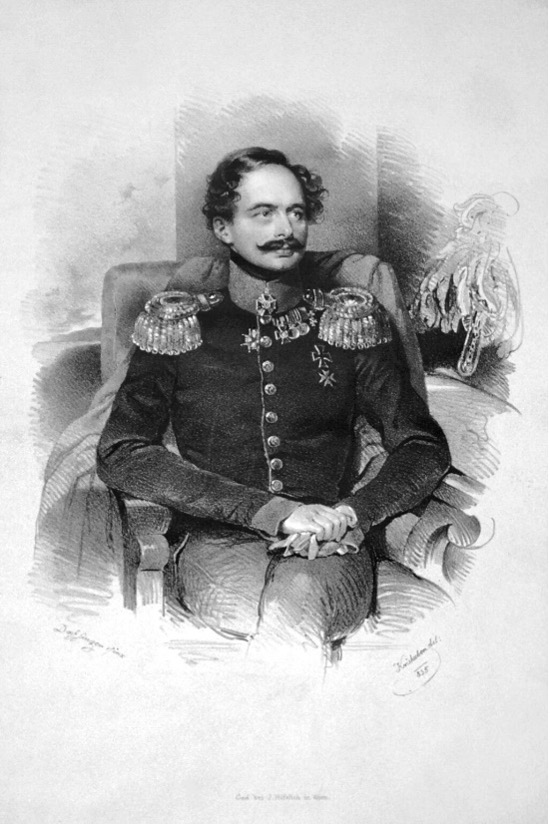
Grand Duke Adolph (1817–1905) became, at the age of 73, the first ruler of Luxembourg’s national dynasty. Since then, his direct descendants have succeeded one another on the throne.
He acquired the ruins of Vianden Castle as well as Berg Castle, and later purchased Fischbach Castle in 1891.
Although he had become head of state, he preferred to reside at Hohenburg Castle in Bavaria and left the management of political affairs to the Luxembourgish Prime Minister, Paul Eyschen. To the population, the dynasty therefore appeared distant from the day-to-day decisions of the State.
Grand Duke Adolph passed away on 17 November 1905 at Hohenburg Castle.
His eldest son, Guillaume IV (1852–1912), was appointed Lieutenant-Representative in 1902 and officially succeeded his father in 1905. During his oath-taking ceremony, he emphasized that the Grand Duke must remain independent of political parties and above partisan disputes.
For health reasons, he appointed his wife, Marie-Anne of Braganza, as Lieutenant-Representative in 1908. She took the oath as Regent on 19 November 1908.
Guillaume IV died in 1912 without a male heir. His union with Marie-Anne of Braganza, however, resulted in six daughters: Marie-Adélaïde (1894), Charlotte (1896), Hilda (1897), Antonia (1899), Elisabeth (1901), and Sophie (1902).
To avoid an inevitable succession crisis, Guillaume IV had acted in advance by adopting, in 1907, a new statute of the Grand-Ducal House, designating his eldest daughter, Princess Marie-Adélaïde, as heir to the throne.
The Chamber of Deputies approved this statute on 16 April 1907, and it became legally valid on 10 July 1907.
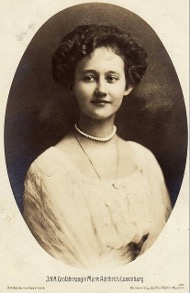
Grand Duchess Marie-Adélaïde (1894–1924)
Marie-Adélaïde was the first ruler born on Luxembourgish soil since John the Blind in 1296. She took the constitutional oath on 18 June 1912.
Two years later, on 2 August 1914, German troops invaded the Grand Duchy. The government and the Grand Duchess protested but could not prevent the violation of Luxembourg’s neutrality. The German occupiers ultimately interfered little in the country’s internal politics.
After the death of Paul Eyschen in 1915, Marie-Adélaïde decided to take a more active role in state affairs. Poorly advised and influenced by bad counsellors, she attempted to maintain a conservative minority government. This decision quickly provoked the anger of the opposition, which accused her of straying from the spirit of the Constitution.
Yet, during her oath ceremony, Marie-Adélaïde had clearly expressed her intention to govern with fairness and respect for the law, declaring:
“My actions will always be guided by the desire to judge according to the requirements of law and justice.”
It should also be recalled that the socialists had already opposed the monarchy in 1907 during the debates on the new family statute. Although Marie-Adélaïde never exceeded her constitutional powers, she drew long-lasting hostility from the political left.
After the Armistice of 1918, her opponents immediately demanded her abdication. She was accused of having shown too much sympathy toward Germany, in particular for having received Emperor Wilhelm II in 1914.
Violent unrest directed against the dynasty broke out, and Marie-Adélaïde eventually accepted the advice of Émile Reuter: she abdicated in favour of her younger sister Charlotte on 9 January 1919.
She then left Luxembourg and entered the Carmelite convent in Modena, Italy.
She died on 24 January 1924 at Hohenburg Castle.